
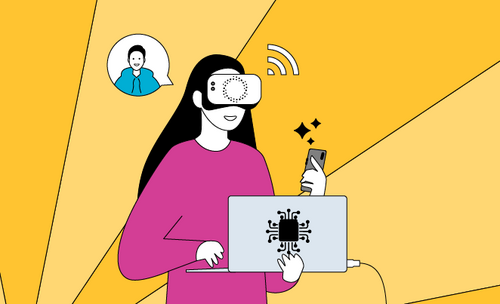
Shaping the future of SLT with technology
This webinar is organised by the Dutch Speech-Language Association (NVLF) as part of the European Day of Speech and Language Therapy (6 March). Across Europe, the day highlights the role of speech and language therapy in enabling people to communicate and participate in everyday life — at school, at work, and in social settings.
The European theme this year is Shaping the future of speech and language therapy with AI. In the Netherlands we take a wider perspective on technology, with AI as one important element alongside other digital developments. During the webinar, we explore the impact of technology on speech and language therapy practice: how technology is being used today and what opportunities it offers for the future.
As a starting point for this webinar, we use the recently published book Artificial Intelligence, Extended Reality, and Automation in Speech-Language Pathology: Integrating Technology Into Clinical Practice. We will be in conversation online with the authors from the US: Michelle Boisvert and Nerissa Hall (both speech-language therapists, PhD, CCC-SLP).
The authors share insights from current research, practical guidance, and future-oriented perspectives. They show how speech and language therapists can already use digital solutions in their daily work, while also preparing for developments ahead. There is explicit attention to ethical questions: how can technology be used responsibly, in ways that support and strengthen the therapist rather than replace them?
Gareth Walkom (co-author and founder of WithVR) will reflect on the discussion from the perspective of innovation and applied technology. Joeri van Ormondt (speech and language therapist and practice owner) will add reflections from clinical practice, connecting the insights from the book to everyday work in speech and language therapy.
The approach of the webinar is simple and practical. We start from the therapist and the client’s support needs. Which technology can help you in your work? In some cases this may be artificial intelligence; in others, a different type of technology may be more appropriate.
Do you already have questions about this topic?
Please send them to communicatie@nvlf.nl. We will bundle the questions and put them to the speakers during the webinar.
You can follow the webinar from your computer, tablet, or phone.
The European theme this year is Shaping the future of speech and language therapy with AI. In the Netherlands we take a wider perspective on technology, with AI as one important element alongside other digital developments. During the webinar, we explore the impact of technology on speech and language therapy practice: how technology is being used today and what opportunities it offers for the future.
As a starting point for this webinar, we use the recently published book Artificial Intelligence, Extended Reality, and Automation in Speech-Language Pathology: Integrating Technology Into Clinical Practice. We will be in conversation online with the authors from the US: Michelle Boisvert and Nerissa Hall (both speech-language therapists, PhD, CCC-SLP).
The authors share insights from current research, practical guidance, and future-oriented perspectives. They show how speech and language therapists can already use digital solutions in their daily work, while also preparing for developments ahead. There is explicit attention to ethical questions: how can technology be used responsibly, in ways that support and strengthen the therapist rather than replace them?
Gareth Walkom (co-author and founder of WithVR) will reflect on the discussion from the perspective of innovation and applied technology. Joeri van Ormondt (speech and language therapist and practice owner) will add reflections from clinical practice, connecting the insights from the book to everyday work in speech and language therapy.
The approach of the webinar is simple and practical. We start from the therapist and the client’s support needs. Which technology can help you in your work? In some cases this may be artificial intelligence; in others, a different type of technology may be more appropriate.
Do you already have questions about this topic?
Please send them to communicatie@nvlf.nl. We will bundle the questions and put them to the speakers during the webinar.
You can follow the webinar from your computer, tablet, or phone.